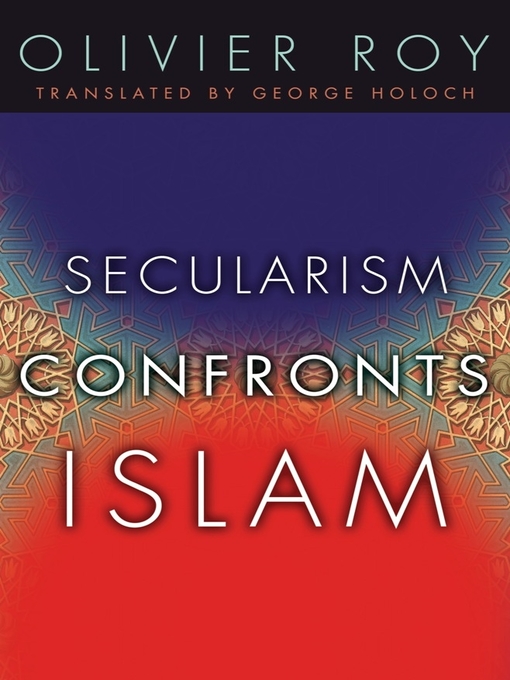
The denunciation of fundamentalism in France, embodied in the law against the veil and the deportation of imams, has shifted into a systematic attack on all Muslims and Islam. This hostility is rooted in the belief that Islam cannot be integrated into Frenchand, consequently, secular and liberal-society. However, as Olivier Roy makes clear in this book, Muslim intellectuals have made it possible for Muslims to live concretely in a secularized world while maintaining the identity of a "true believer." They have formulated a language that recognizes two spaces: that of religion and that of secular society.
Western society is unable to recognize this process, Roy argues, because of a cultural bias that assumes religious practice is embedded within a specific, traditional culture that must be either erased entirely or forced to coexist in a neutral, multicultural space. Instead, Roy shows that new forms of religiosity, such as Islamic fundamentalism and Christian evangelicalism, have come to thrive in post-traditional, secular contexts precisely because they remain detached from any cultural background.
In recognizing this, Roy recasts the debate concerning Islam and democracy. Analyzing the French case in particular, in which the tension between Islam and the conception of Western secularism is exacerbated, Roy makes important distinctions between Arab and non-Arab Muslims, hegemony and tolerance, and the role of the umma and the sharia in Muslim religious life. He pits Muslim religious revivalism against similar movements in the West, such as evangelical Protestantism and Jehovah's Witnesses, and refutes the myth of a single "Muslim community" by detailing different groups and their inability to overcome their differences.
Roy's rare portrait of the realities of immigrant Muslim life offers a necessary alternative to the popular specter of an "Islamic threat." Supporting his arguments with his extensive research on Islamic history, sociology, and politics, Roy brilliantly demonstrates the limits of our understanding of contemporary Islamic religious practice in the West and the role of Islam as a screen onto which Western societies project their own identity crisis.
- New eBook additions
- New eBook additions for Kids
- New eBook additions for Teens
- Most popular
- Most popular for Kids
- Most popular for Teens
- Available Now
- Available Now for Kids
- Available Now for Teens
- Book Club 2025-2026: Guaranteed Available : Karapu Pukapuka: Wātea Mārika 2025-2026
- Classic Literature Book Club : Guaranteed Available
- Travel Club 2025-2026: Guaranteed Available
- Reese's Pieces
- See all ebooks collections
- New eAudiobook additions
- AudioBook Club 2026-2027: Guaranteed Available
- New eAudiobook additions for Kids
- New eAudiobook additions for Teens
- Most popular eAudiobooks
- Classic "Reads" AudioBook Club : Guaranteed Available
- Most popular eAudiobooks for Kids
- Most popular eAudiobooks for Teens
- Available now on eAudio
- Available Now on eAudio for Kids
- Available Now on eAudio for Teens
- See all audiobooks collections
- Ngā pukapuka i te reo Māori : Books in the Māori Language
- Tusi Samoa : Samoan Books
- Ngaahi tohi ʻi he lea faka-Tongá : Books in Tongan
- 中文书籍 Zhōngwén shūjí : Books in Chinese
- 中文杂志 Zhōngwén zázhì : Magazines in Chinese
- മലയാളത്തിലെ പുസ്തകങ്ങൾ : Books in Malayalam
- Cărți în limba română: Books in Romanian
- Книги українською мовою : Books in Ukrainian
- Książki w języku polskim : Books in Polish
- किताबें हिंदी में Kitaaben hindee mein : Books in Hindi
- Buugaag af-soomaali ku qoran : Books in Somali
- Livres en français : Books in French
- Magazines en français : Magazines in French
- See all language collections collections